| Applying Indian Rhythms 3 |
A look at the Rhythms of
South India and how to apply them musically.
One of the greatest skills a
percussionist / drummer can strive for is the ability to be able to
present and perform a variety of rhythmic ideas in a fluid and flowing
manner without interrupting the momentum of the piece. Particularly when
improvising and in solos, it is quite a challenge to keep it all moving
along nicely whilst also coming up with fresh and appropriate ideas.
Here we will look at Corvay structures
from South India. A Corvay is an elaborate rhythmic composition
(referred to as 'parent' composition in the article) components of which
are introduced into the basic rhythm structure prior to it being played.
Each rhythmic motif introduced could be looked at as a module of the
larger 'parent' composition, which will be performed when the modules
have been introduced within the rhythm to a sufficient degree. This
often involves gradually increasing the ratio of rhythmic motifs to
basic rhythm pattern. These concepts will become clearer when the
musical examples later in the article are referred to. The road map of
the concept would look a bit like this:
- BASIC RHYTHM
STRUCTURE (GROOVE)
- GROOVE WITH RHYTHMIC MOTIFS INTRODUCED GRADUALLY
- CORVAY (PARENT COMPOSITION MADE UP OF RHYTHMIC MOTIFS)
- RETURN TO GROOVE
These 'parent' compositions (corvays)) often involve the use of lyrical
'lick'-type phrases juxtaposed with syncopated endings which start with
the notes spaced widely and increase tension as they get compressed into
a denser and more intense structure.
To look at the way this all fits together we need firstly to look at the
'parent' composition (Corvay), its components, and then how elements and
phrases from it are introduced into the basic rhythm pattern. We will
also look at a few possible voicing’s for kit. What I'm really trying to
put across here is the concept behind the structure which could then be
developed by you personally to fit the contours and directives of your
own playing style.
Right then, basically the corvay under the microscope can be split into
two halves. Firstly we have the 'rhythmic phrase' section, and secondly
the 'rhythmic syncopation' section. (By the way, these styles of
compositions would be played on most Carnatic classical drums such as
Mridangam, kanjira, ghatan and even the mouth harp, morsing). These
phrases are sometimes referred to as ‘North’ and ‘South’ parts of the
composition. If we look at the germ of the first part of this
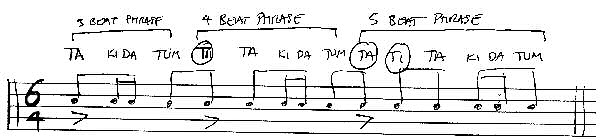
composition ('rhythmic phrase' section) we get the simple 6., 4 phrase
as in example one. This is comprised of a phrase divided 3+4+5.
EXAMPLE 1 Click to
enlarge

This is best thought of as made up of
three tiny phrases, three, four, and five eighth notes long
respectively. This is where the contours of the rhythm fall (indicated
by the accents in example one). The ringed notes are the added notes at
the head of each phrase which makes it longer each time. This
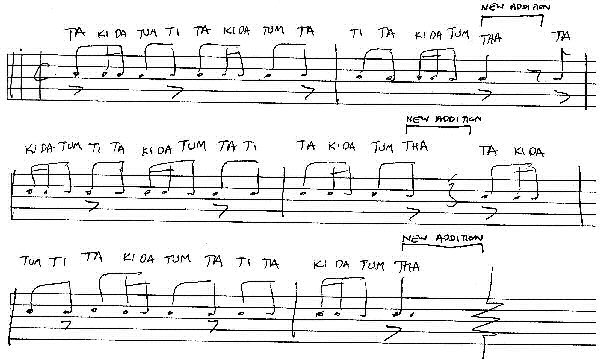
phrase is now repeated three times, thrown off beat by the inclusion of
a dotted quarter note added in each time the line is repeated (see
example two - indicated by 'new addition' marking over score).
This example ends in the middle of the bar. This is where the
second part of the composition will begin.
EXAMPLE 2 Click to enlarge
Note that this is notated in duple time,
as the whole composition is constructed so as to fit into 4/4, or 'adi
thala', as it is known in South India.
At this point is it important to mention that it's more difficult to
understand this kind of rhythm if you listen to it in 4 /4. At the end
of the day it is true that one needs to feel the quartet note pulse
underneath, but it is vitally important to listen to, and recognize the
individual phrases and odd-length building blocks. Try clapping a steady
quarter note pulse whilst reciting the syllables, concentrating not only
on the pulse, but also on the phrase portions.
On to the second section. All the syncopations in this part are created
from this five beat phrase TA TI KI DA TUM. This section actually begins
on beat two of bar six. It is a simple reduction-in-length system, which
begins with each syllable being three eighth notes long, then two eighth
notes long, (repeated once), and then one eighth note long, repeating in
a cadence-like structure in groups of three. This is very common to
Indian rhythm, and is a great, exciting way to end a rhythmic
composition. Example three shows the whole 'parent' composition.
Remember, the second part starts on beat: two of bar six.
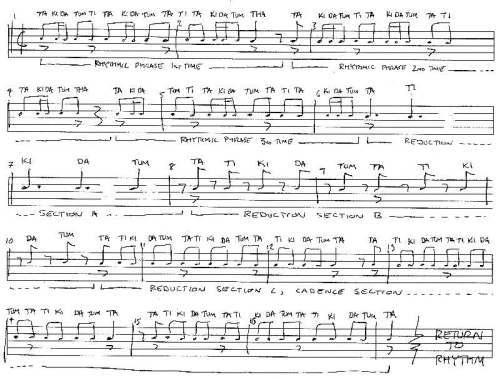
EXAMPLE 3 Click to enlarge
Now we can look at the manner in which
the phrases are introduced into the basic rhythm that would naturally be
played before and after the corvay. (The equivalent would be playing a
groove on the kit and gradually introducing phrase-based fills which
would be component parts of a larger rhythmic composition to be played
at a certain point.) Example four, a/b/c show how the early
components would be introduced one by one into the basic rhythm
structure, getting longer each time around.

EXAMPLE 4 Click to enlarge

EXAMPLE 5 Click to enlarge

EXAMPLE 6 Click to enlarge
Just before the 'parent' composition is
played, the reduction (corrapoe) section comes around. Corrapoe
indicates reduction in the length of the basic rhythm (groove) between
the phrases. This would transpire as in the following examples. As you
can see, the phrases are beginning to take over from the basic rhythm.
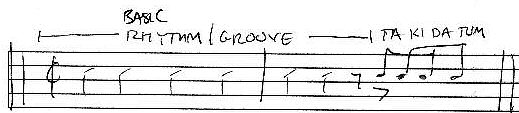
EXAMPLE 7
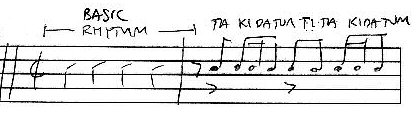
EXAMPLE 8

EXAMPLE 9
Then it would be on to the full rendition
of the 'parent' composition (Ex 3), possibly, three times in a row
before returning to the basic rhythm and introduction of new phrases
leading to a new parent composition with a totally different theme. It's
certainly a great way to build solos and develop ideas.
Finally, on to a few voicing’s for drum set. I'm just skimming the
surface here, employing the tum sound as our bass drum and the other
syllables spread between the snare and toms. (tum is the sound that
would be played on the open bass tone of the Mridangam drum. It is also
similar to phonetics from the Middle East which represent open bass
tones on frame drums and dumbek etc. The other syllables would more
likely be articulated on more staccato tones.) In particular, the
voicing’s for the phrases TA TI KI DA TUM (stemming from the syncopated
section) sound effective when they move through the time shifts of
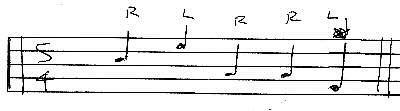
phrases length reductions. When you have put together these phrases to
make up the 'parent' composition, try playing time with the left foot as
in the example at the bottom of the page. Have fun!
Sticking variations for
first part of composition.


Sticking variations for
second part of composition.
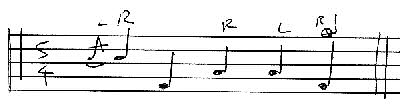
Try playing the whole
composition whilst maintaining these these hi hat patterns

Click to enlarge

|